
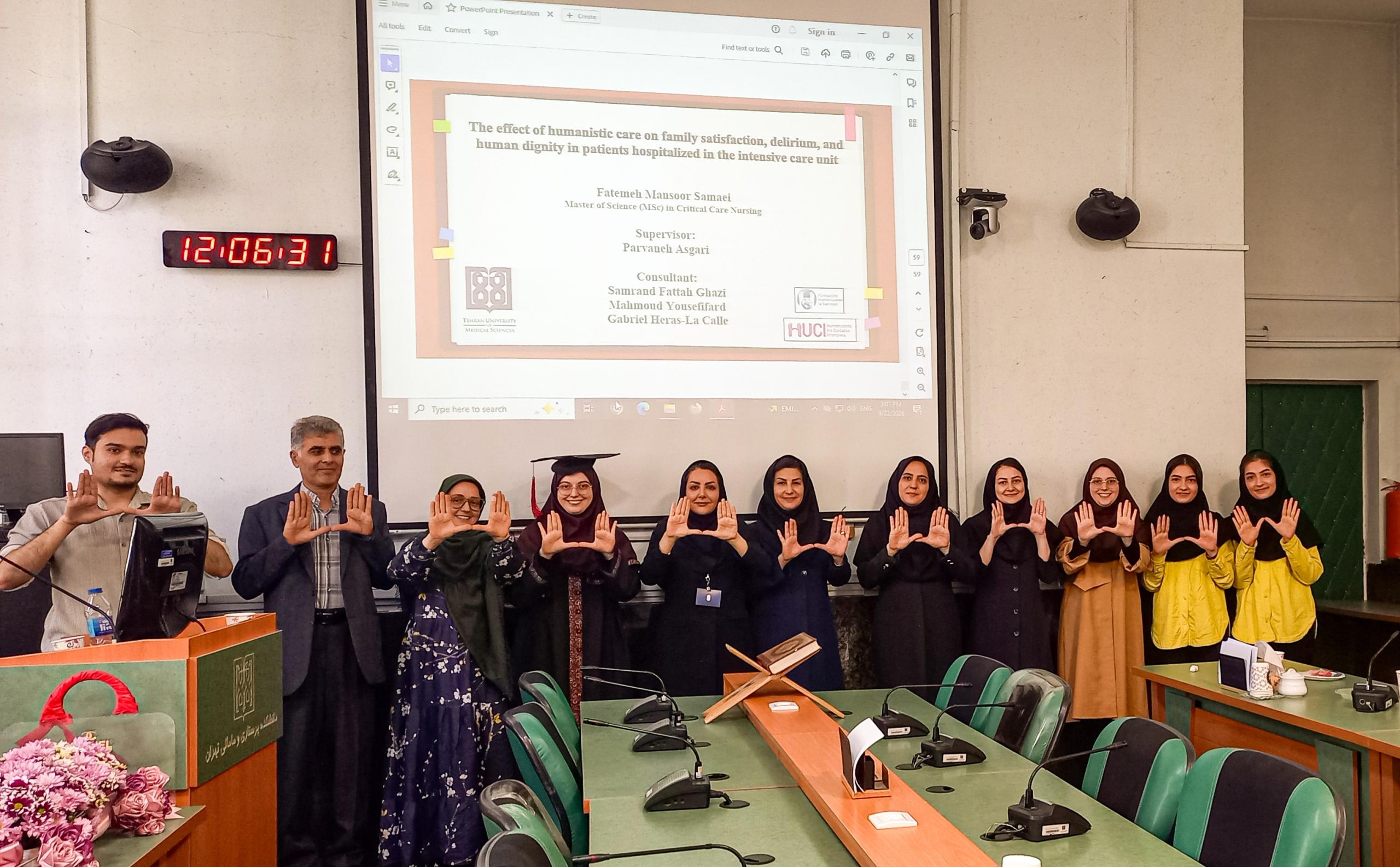
Every ICU tells a story. Behind every patient is a person with individual needs, a family seeking reassurance, and healthcare professionals striving to provide the best possible care. Humanizing intensive care means recognizing these human needs alongside clinical priorities.
Inspired by Proyecto HU-CI in Spain, our team embarked on a journey to implement humanized care in an Iranian intensive care unit. This project formed the basis of my master’s thesis in critical care nursing and became an important step in exploring how the HU-CI model could be put into practice in our clinical setting.
Guided by the seven dimensions of the HU-CI model, we developed a set of interventions focusing on patients, families, and healthcare professionals. Our aim was to evaluate whether a more human-centered approach could improve patients’ dignity, family satisfaction, and delirium-related outcomes.
Bringing the Model into Clinical Practice
The study was conducted in a general ICU at Mahdi Clinic, Imam Khomeini Hospital Complex, Tehran, Iran. Using a two-group, quasi-experimental, post-test-only design, we included 194 patient–family pairs, allocated non-randomly and equally to an intervention group and a usual-care control group.
Implementation began with communication-focused interventions for nurses, designed to strengthen interactions among staff and improve communication with patients and families. These activities were delivered over four weeks before recruitment to the intervention group began.
We then introduced practical changes intended to make the ICU environment more responsive to patients’ needs. Patients could use their glasses, hearing aids, and dentures, helping them maintain contact with their surroundings and preserve a sense of identity and independence. Flexible visiting arrangements offered families greater opportunities to remain connected with their loved ones.
Families received a Welcome Guide upon ICU admission to help them understand the environment, find answers to common questions, and become better informed about the care process. We also made clocks visible to patients and took steps to reduce excessive environmental noise and light. Eye masks and earplugs were provided free of charge for patients who wished to use them.
These interventions were practical, but their purpose extended beyond individual actions. Together, they represented an effort to make intensive care more attentive to patients’ dignity, comfort, communication, and relationships with their families.
What did we learn?
Our findings showed significantly better patient dignity scores and higher family satisfaction in the intervention group than in the usual-care group. These results suggest that implementing humanized care practices may help strengthen the preservation of patient dignity and improve families’ experiences of intensive care.
However, the findings regarding delirium require caution. The number of documented delirium cases was insufficient to support a definitive conclusion about the intervention’s effect on this outcome. Further studies with more comprehensive delirium assessment and larger samples are needed to clarify this relationship.
For our team, these findings reinforced an important principle: humanizing intensive care is not limited to major structural changes or sophisticated technologies. Attention to communication, sensory needs, environmental comfort, and family involvement can be incorporated into everyday clinical practice.
From an Iranian ICU to a Shared International Vision
Implementing the HU-CI model in Iran has been a valuable learning experience. It has shown us the importance of translating humanization principles into practical interventions while evaluating their effects systematically in the local clinical context.
We are grateful to Dr. Gabriel Heras-La Calle and Proyecto HU-CI for the inspiration and framework that helped guide this work. Sharing our experience is an opportunity to contribute to the wider international conversation about humanized intensive care and to learn from colleagues working toward the same goal in different healthcare systems.
The study protocol is available in BMJ Open (DOI: 10.1136/bmjopen-2026-117507). We look forward to sharing the full findings of this research with the scientific and clinical community.
Ultimately, our aspiration is simple: that every patient, regardless of where they receive care, is treated not only as a person with a medical condition, but as a human being whose dignity, relationships, and individual needs matter. Bringing the HU-CI model into practice in Iran is one step toward that shared vision.
For further information, please contact:
Fatemeh Mansoor Samaei: fatemehsamaei1380@gmail.com
Dr. Parvaneh Asgari: p-asgari@sina.tums.ac.ir



Leave A Comment